Literature review
Mechanism, evidence, and the limits of what twenty-five years of Epitalon research establishes.
A systematic reading of the primary literature from 2000 to 2025, organized by mechanism and species.
The short version
Epitalon's research record organizes into two questions: what does the published literature say the peptide does, and how much trust does that literature deserve? On the first question, two mechanisms dominate — telomerase activation in cell culture (the AEDG sequence induces hTERT, the enzyme's catalytic subunit, and extends telomeres) and stimulation of the pineal melatonin-synthesis pathway (via the enzyme AANAT and its transcription factor pCREB). On the second question, the honest answer is qualified: nearly all of the evidence comes from a single research group based in St. Petersburg. The 2025 Al-dulaimi et al. study from the UK and Australia confirmed telomere extension in human cell lines by an independent team — the first such confirmation — but lifespan, primate, and most clinical findings remain unconfirmed outside the originating program. No large randomized trial in humans exists. The pages below set out the primary evidence cluster by cluster.
Structure and origin
Epitalon (Ala-Glu-Asp-Gly; AEDG) is a tetrapeptide of molecular weight 390.35 Da. Its sequence was isolated from Epithalamin, a polypeptide extract of bovine pineal gland developed by Khavinson's group in the 1970s and 1980s. The compound is stabilized by two intramolecular salt bridges — between the N-terminal alanine and the carboxylate groups of glutamic acid and aspartic acid — and one intramolecular hydrogen bond. These structural features restrict conformational flexibility and are proposed to underlie the peptide's resistance to rapid hydrolysis. LC-MS/MS analysis confirmed the AEDG sequence is present endogenously in the human pineal gland [13], lending the compound a different status than a wholly foreign synthetic — it appears to be a fragment of an endogenous peptidergic signal rather than a xenobiotic. The eight possible stereoisomers of the four amino acids have not been systematically compared; only the L-amino acid configuration has been studied [13].

Telomerase activation and telomere extension
Telomeres — the TTAGGG-repeat caps protecting chromosome ends — shorten with each cell division. Critically short telomeres trigger cellular senescence or apoptosis. Telomerase (hTERT), the enzyme that adds telomeric repeats, is silenced in most adult somatic cells but active in stem cells and most cancer cells. The restoration of telomerase activity in aging somatic cells has long been a theoretical target in geroprotection research.
In 2003, Khavinson, Bondarev, and Butyugov demonstrated that Epitalon induced expression of hTERT and restored telomerase enzymatic activity in telomerase-negative human fetal fibroblast cultures, producing measurable telomere elongation [1]. This was among the first reports of a peptide capable of reactivating telomerase in normal somatic cells.
A 2025 follow-up by Al-dulaimi, Thomas, Matta, and Roberts [2] — conducted by an independent group at institutions in the United Kingdom and Australia — provided the field's most mechanistically detailed characterization to date. Using Epitalon at 0.2–1 µg/ml in four human cell lines, the investigators found a differential mechanism: in normal fibroblasts (IBR.3) and epithelial cells (HMEC), telomere extension occurred through hTERT upregulation (12-fold in IBR.3 cells) and a 4- to 26-fold increase in telomerase activity, requiring three weeks of treatment. In breast cancer lines (21NT, BT474), extension was mediated primarily by alternative lengthening of telomeres (ALT) — a recombination-based mechanism independent of telomerase — producing a 10-fold increase in 21NT cells within four days and a maximum telomere extension from 2.4 kb to 4 kb. The differential behavior raises a mechanistic question that remains unresolved: the activation of ALT in cancer cells is observed without activation in normal cells, suggesting some degree of context-dependence in the pathway activated [2].
The 2003 hTERT study [1] originated from the Khavinson group. The 2025 Al-dulaimi study [2] represents independent replication by a non-Russian team — the first such published confirmation in the telomere domain. All other mechanism studies cited on this page originate from the St. Petersburg Institute of Bioregulation and Gerontology or its collaborators.

Pineal and circadian regulation: the AANAT/pCREB pathway
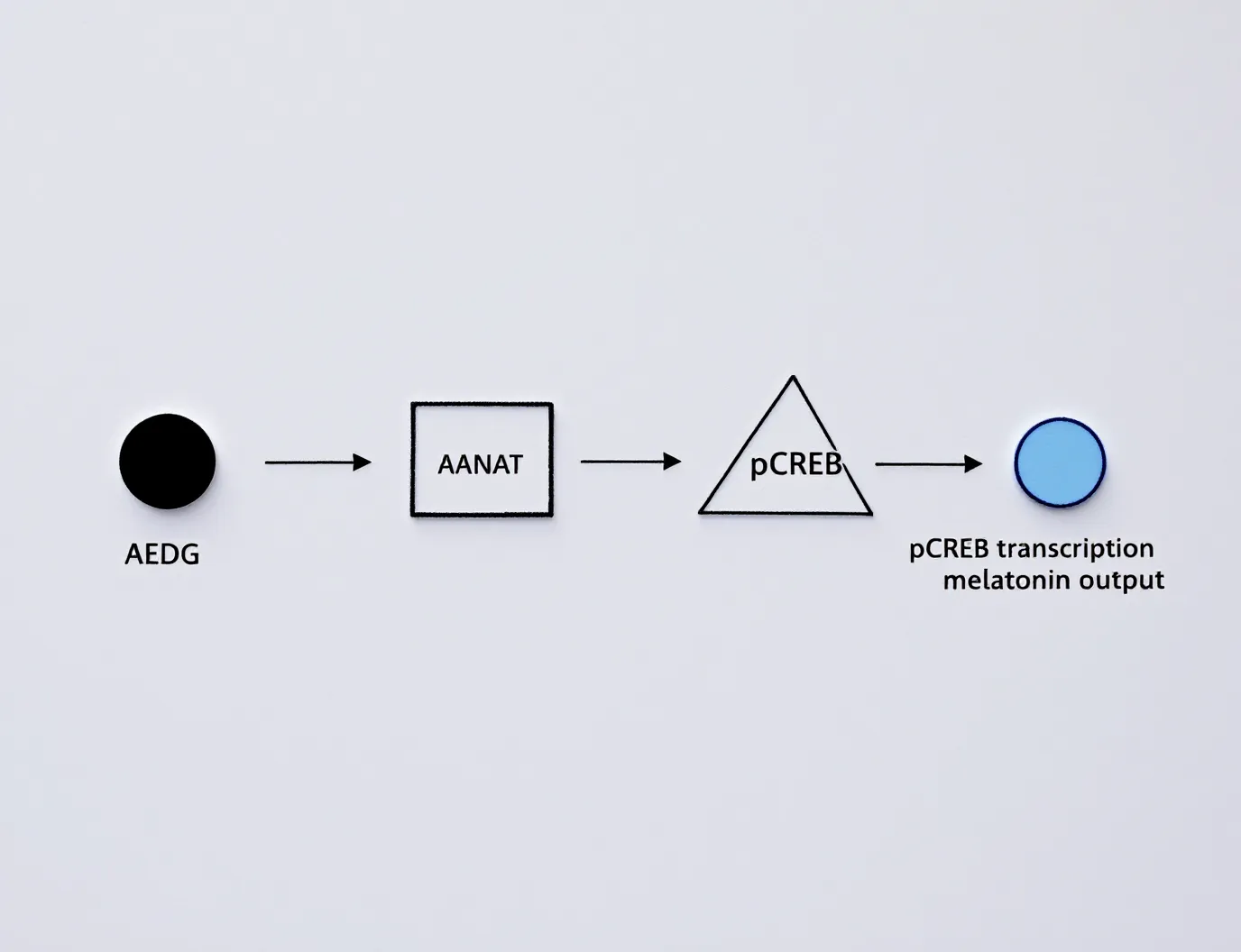
Melatonin synthesis in pinealocytes is rate-limited by the enzyme arylalkylamine N-acetyltransferase (AANAT), whose expression is controlled by the transcription factor pCREB (phosphorylated cAMP response element-binding protein). In cultured rat pinealocytes, Epitalon modulated both AANAT expression and pCREB activity within three hours of incubation, producing direct stimulation of melatonin synthesis at effects more potent than those observed with the comparison peptide Vilon [17]. In pinealectomized Wistar rats treated for 42 days, Epitalon restored the ratios of serotonin-producing, gastrin-producing, and somatostatin-producing cells to levels approximating intact controls [17] — suggesting the compound's melatonin-regulatory activity extends to effects downstream of the pineal gland itself.
In non-human primates, senescent rhesus macaques (Macaca mulatta, ages 20–26 years) showed disrupted melatonin and cortisol circadian patterns characteristic of aging. Intramuscular Epitalon at 10 µg/kg over 10 days restored evening melatonin elevation and normalized cortisol diurnal rhythm; glucose tolerance also improved, with glucose response area decreasing from 479.6 ± 38.0 to 388.9 ± 43.6 mM/min (p<0.05) [11]. Effects reversed within one month of treatment cessation.
The most directly human-relevant circadian evidence comes from a clinical series in 75 women with accelerated pineal aging, receiving sublingual Epitalon at 0.5 mg/day for 20 days [15]. Melatonin urinary excretion increased 1.6-fold. Clock gene (per the circadian transcriptional-translational feedback loop) expression decreased 1.8-fold; Cry2 expression doubled; Csnk1e expression decreased 2.1-fold — all with statistical significance at p<0.05. This represents the only published human data on Epitalon's circadian effects and derives from a single open-label study with no placebo arm, conducted by the Khavinson group [15].
Lifespan and anti-tumor findings in rodent models
The bulk of Epitalon's in vivo longevity evidence comes from a series of rodent lifespan studies conducted by Anisimov, Khavinson, Popovich, Zabezhinski, and colleagues between 2002 and 2005.
In female Swiss-derived SHR outbred mice, Epitalon at 1 µg/mouse subcutaneously for 5 consecutive days per month from age 3 months extended mean lifespan of the last 10% of survivors by 13.3% and maximum lifespan by 12.3% [3]. The same study documented a 17.1% reduction in bone marrow chromosomal aberrations (p<0.05), inhibition of leukemia development 6.0-fold, and slower estrous cycle aging. The antimutagenic effect exceeded that of melatonin tested under the same protocol.
In transgenic FVB/N HER-2/neu female mice — a model of spontaneous breast adenocarcinoma — Epitalon at 1 µg subcutaneously five times per week from age 2 months extended average lifespan 13.5% and maximum lifespan 13.9%, decreased breast adenocarcinoma incidence 1.6-fold, reduced multiple-tumor animals 2-fold, increased tumor-free animals 3.7-fold, and suppressed HER-2/neu mRNA expression in tumor tissue [4].
In chemically induced colon carcinogenesis in male LIO rats (1,2-dimethylhydrazine model), subcutaneous Epitalon at 1 µg/rat significantly reduced tumor incidence and multiplicity in both ascending and descending colon when administered throughout the DMH-exposure period, increased stromal lymphoid infiltration adjacent to tumors, inhibited mitotic activity, and elevated apoptosis in tumor tissue [6]. A parallel study in female C3H/He mice bearing spontaneous carcinomas found no metastases in the Epitalon-treated group versus 3 of 9 metastasis-bearing controls; the study ran 6.5 months at 0.1 µg/mouse five times weekly [7].
In senescence-accelerated SAMP-1 mice, both Epitalon (1 µg/mouse subcutaneously, 5 times per week monthly) and melatonin (in drinking water) extended mean and maximum survival in the last 10% of survivors, without significant effect on overall tumor incidence in that strain [8].
In Drosophila melanogaster wild-type Canton-S imagoes, dietary Epitalon at concentrations from 0.001×10⁻⁶ to 5×10⁻⁶ wt.% extended lifespan 11–16% in males and 11–13% in females [5]. The effective concentrations were 16,000-fold lower than those required for melatonin to produce comparable results, and the authors proposed an antioxidant mechanism.
An important interpretive note: the primary lifespan effect in several of these studies is concentrated in the last 10% survivor cohort — the maximum lifespan metric. Effect on median lifespan (which is more resistant to outlier influence) was not always statistically significant. The NIA Interventions Testing Program, which evaluates longevity compounds in genetically heterogeneous mice under standardized conditions at three independent sites, has not tested Epitalon.
Retinal, renal, neurological, and stem cell findings
Beyond longevity and tumor suppression, the Epitalon research record includes findings in several other biological systems.
Retina. Parabulbar injection of Epitalon in Campbell rats with retinitis pigmentosa extended functional retina area by 43.9%; intraperitoneal injection during pregnancy produced a twofold extension of functional retina in offspring [12]. A clinical study in 162 patients (ages 18–72) receiving 5.0 µg/eye parabulbar for 10 consecutive days reported a positive clinical outcome in 90% of cases, average visual acuity improvement of 0.15–0.20 on the standard scale, and peripheral visual field expansion of 90–120 degrees in 64.8% of patients, with no reported adverse effects [12]. This open-label series remains the largest published human dataset on Epitalon. In 2025, Gatta et al. [19] extended the retinal evidence to an in vitro diabetic retinopathy model: Epitalon at 20–60 ng/mL fully restored high-glucose-impaired wound closure in ARPE-19 human retinal pigment epithelial cells, reduced hydrogen peroxide generation, rescued antioxidant gene expression (SOD2, CAT, HMOX1), and inhibited epithelial-mesenchymal transition markers (SNAIL-1, ZEB-1, TWIST1) at all tested concentrations.
Kidney. In Wistar rats with glycerol-induced acute kidney failure, Epitalon at 7 µg/kg intraperitoneally for 7 days increased diuresis, decreased proteinuria, and elevated catalase and glutathione peroxidase activity in renal tissue [13]. Nephroprotective findings were also reported in cisplatin-induced nephropathy and in aged rats without induced pathology.
Neurology. In SH-SY5Y human neuroblastoma cells, Epitalon increased acetylcholinesterase and butyrylcholinesterase activity by 10–25% and elevated soluble amyloid precursor protein secretion by 20% [13]. Intranasal Epitalon at 0.5–20 ng in rats increased spontaneous neuronal activity in parietal and frontal neocortex within 5–7 minutes. In human fibroblast-derived neurons, Epitalon reduced DNA oxidative damage (8-hydroxydeoxyguanosine) and increased dendritic quantity and length [13].
Stem cells. In human gingival mesenchymal stem cells, the AEDG peptide increased neurogenic differentiation marker mRNA expression (Nestin, GAP43, beta-Tubulin III, Doublecortin) by approximately 1.6–1.8-fold; molecular modeling identified preferential binding to histone H1/6 and H1/3 at DNA-interface sites, suggesting an epigenetic mechanism [9]. In a separate study, AEDG reduced expression of senescence markers p16 by 1.56–1.92-fold and p21 by 2.22–2.44-fold in two oral stem cell types after the 25th passage, where replicative senescence normally accelerates [10].
Reproductive biology. Epitalon at 0.05–0.1 mM improved bovine oocyte maturation rate (p<0.05), enhanced post-thaw blastocyst hatching and implantation potential (p<0.05), elevated mitochondrial membrane potential and mtDNA copy number, reduced reactive oxygen species, and upregulated PGC-1α, Sirt-1, tFAM, and BCL2 mRNA — the first published application of Epitalon's telomerase-activating mechanism in assisted reproduction [20].
Immune regulation. At ultra-low concentrations (10⁻¹⁷–10⁻¹⁵ M), Epitalon exhibited mitogenic activity in murine thymocytes and elevated IL-2 mRNA in mouse splenocytes within 5 hours — faster and more potent than the comparison peptide Vilon — with subsequent IL-2 mRNA elevation in rat hypothalamus 24 hours after intramuscular injection [13].
With the exceptions of the 2025 Al-dulaimi telomere study [2] and the 2025 Gatta retinal wound-healing study [19], every finding reported on this page originates from the Khavinson group or its direct collaborators at the St. Petersburg Institute of Bioregulation and Gerontology. Independent multicenter replication of the lifespan, tumor, pineal, renal, and neurological findings has not been published.